About KEV data sources
Note
KEV integration requires Dependency-Track 5.1 or newer.
A KEV data source is an upstream catalog of vulnerabilities confirmed to be actively exploited in the wild. An ordinary vulnerability data source and a KEV data source send different signals. NVD, GHSA, and OSV tell you a vulnerability exists and rate its severity. A KEV assertion tells you exploitation is already happening, a strong signal for remediation priority. Dependency-Track can mirror three KEV catalogs. You don't need any of them, and turning all three on is rarely the right choice.
This page explains what each source contributes and how mirrored assertions attach to vulnerabilities. For the procedure to enable sources, see Configuring KEV sources.
Mirrored sources
Dependency-Track can mirror three KEV catalogs into its own database:
- CISA KEV is on by default and identifies vulnerabilities by CVE ID.
- ENISA EU KEV is on by default and identifies vulnerabilities by CVE ID. Entries the agency publishes without a CVE ID don't produce a KEV assertion.
- VulnCheck KEV is a community catalog. It's off by default and requires a free community API token. It covers vulnerabilities CISA KEV misses, and often records exploitation earlier. Entries it publishes without a CVE ID don't produce a KEV assertion.
Picking sources
- CISA KEV and ENISA EU KEV are free, government-curated, and on by default, so they need no setup beyond outbound network access. Start with these.
- VulnCheck KEV needs an API token but gives you broader and faster coverage. Turn it on when remediation speed matters more than staying with government sources alone.
How Dependency-Track uses the data
Mirroring is a background task. On a configurable schedule, Dependency-Track downloads the current catalog from each enabled source and writes the assertions into its own database. A new deployment runs the task once shortly after it starts, so the first mirror doesn't wait for the schedule. Later restarts don't trigger a mirror.
KEV status doesn't wait for a BOM upload or an analysis run. Dependency-Track checks it by the vulnerability's CVE ID, so a routine mirror run, or turning on a source for the first time, can mark vulnerabilities you already found as known exploited without you doing anything else.
Turning a source off
Turning off a source stops further mirroring from it, but Dependency-Track keeps the assertions it already wrote and does not clean them up. A vulnerability that source flagged as known exploited stays flagged.
How KEV matching works
Dependency-Track matches KEV catalog entries to vulnerabilities by CVE ID, not by anything on your components. If a vulnerability in your portfolio has the same CVE ID as an entry in an enabled KEV catalog, Dependency-Track flags it as known exploited.
This also works across sources that describe the same vulnerability differently. Log4Shell, for example, is
CVE-2021-44228 in NVD and GHSA-jfh8-c2jp-5v3q in GHSA. Dependency-Track tracks that these are the same
vulnerability, so a CISA KEV assertion against
CVE-2021-44228 flags both records as known exploited.
Because matching is by CVE ID, not by CPE or PURL, KEV status doesn't depend on what identifiers your components carry. It only requires Dependency-Track to know the vulnerability's CVE ID, from any vulnerability data source.
Where KEV status appears
Dependency-Track shows a KEV column in the portfolio Vulnerabilities list, the project Findings and EPSS views, and the Vulnerability Audit views. A filter is available to limit the displayed findings.
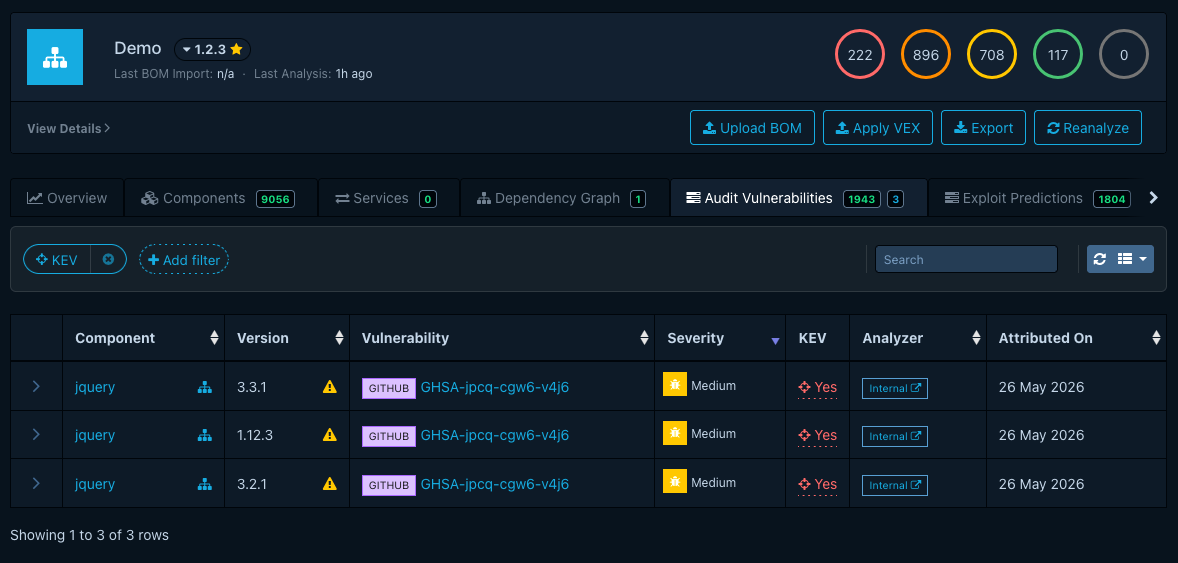
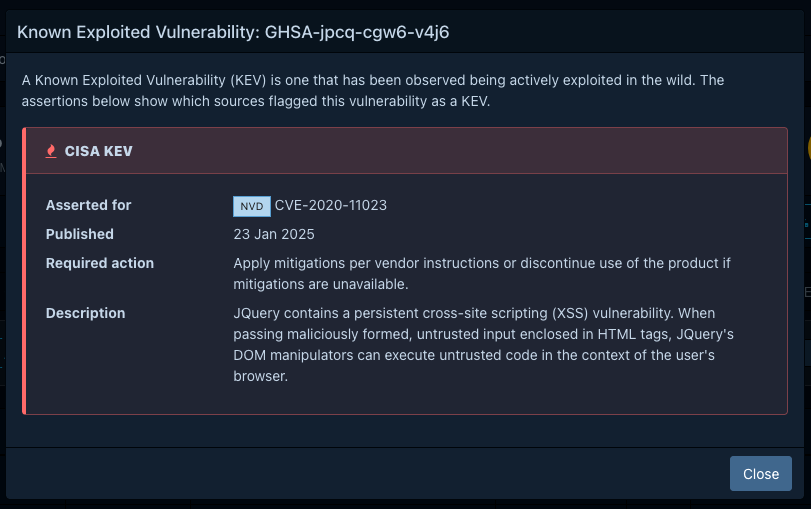
A flagged vulnerability displays a crosshair icon that opens a modal listing each source's assertion: the asserting catalog, whether it reports known ransomware use, the date the catalog added the entry, any required remediation action, and a description.
A component policy condition can match on KEV status, raising a violation when a component carries a known exploited vulnerability. See the example condition expression.
Notifications carry KEV status on their vulnerability subject. A filter expression can restrict an alert to known exploited vulnerabilities, and a notification template can render the flag into the message a publisher sends.
